![O[yes]](https://youngemployeesafety.org/wp-content/uploads/2024/10/logo-tagline-500-new.png "logo-tagline-500-new")
Floors, shoes, and slips: The safety is in the details
by Lisa Hillyard, Authorized OSHA Outreach Trainer
Teens and young workers often work at places with a high risk of slips. Examples include restaurants and fast-food places, grocery stores, retail and big box stores, or janitorial and cleaning jobs. Many of these workplaces have tile or polished concrete floors. Outdoor and landscaping jobs have uneven ground and wet grass or mud.
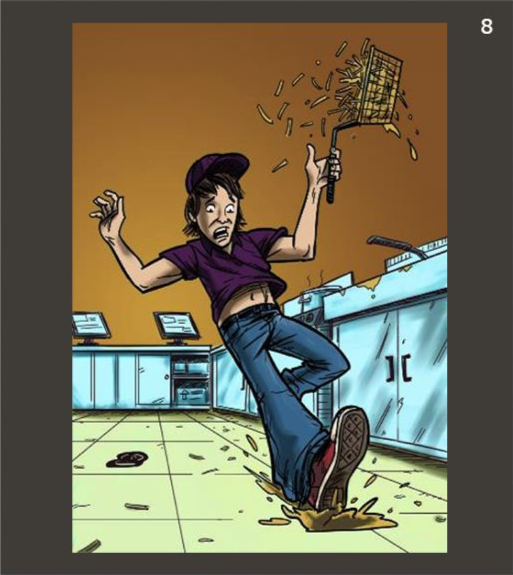
Employers and supervisors try to keep the workplace safe, but water and grease along with spills of food or drinks end up the floor people must walk across. Floors need cleaning. Soap and cleaning chemicals create slippery conditions. Tools get left on the ground, too.
Slip-resistant shoes are required for most of these jobs.
It’s important to understand that your normal sports shoes are not slip resistant. Their soles are made of smooth and untacky materials.
Companies that make slip-resistant shoes make their soles from rubber, PVC, or polyurethane. These materials are sticky and soft. The design of the grooves in the soles allows water to flow away and not get between the bottom of the shoe and the ground. Car tires are also designed to divert water away from the contact between the tire and the road. The more sole surface that contacts the surface of the floor allows more traction to be maintained rather than slipping or skipping across the floor.
The shoe companies test the soles to figure out how much traction the bottom of the shoe has with the surface of the floor. The manufacturers measure the friction of the sole and identify a number called the coefficient of friction (COF). It is a measurement of grip. The coefficient of rubber on dry concrete is 1.0.
Scientific organizations such as the American Society for Testing and Materials (ASTM) sets the testing methods for shoe companies to determine the COF of their soles.
- A higher COF means the shoe has more traction.
- A lower COF means the shoe has more slip risk.
- COFs between 0.30-0.40 offer minimal slip resistance.
- COFs between 0.04-5.50 offer good resistance (depending on walking environment)
When shopping for slip-resistant shoes, some shoe companies will provide the COF measurement. These companies may also provide the testing information (ASTM F2913, SATRA TM144, etc.)
Shoppers can compare brands based on the COFs. Shoppers can identify which shoe has been tested for the specific environment of the job. Water behaves differently than oil. Smooth steel floors are different from textured concrete.
Other companies may only say “slip resistant” on the shoebox. These companies must meet the minimum criteria of slip resistance. In July 2021, ASTM introduced the testing criteria (F3445). This established a minimum COF requirement for footwear to be labeled as slip resistant. Even though the companies must meet this requirement, some of them do not publish their COFs to the public. This test is about the material and tread design of the sole with quartz ceramic tile (clay tile surface). The shoes must be tested with water and oil-water mixture.
Key Comparison
| Feature | COF-Listed Footwear | “Slip-Resistant” Only |
| Measurement | Quantitative (numeric) | Qualitative (claim) |
| Test Standard | Usually specified | Often unspecified |
| Transparency | High | Low |
| Comparability | Yes | No |
| Reliability | Evidence-based | Inconsistent |
| Use in safety programs | Strong | Limited |
Before buying a pair of slip-resistant shoes, know the type of floor at the job. If the job has ceramic tile, then you can be sure that footwear labeled with slip resistant has been tested for that environment.
If the job site has a different type of floor with specialized oils or chemicals, ask the supervisor or safety person if more specialized safety shoes are needed.

